By Uchendu,
P.C.
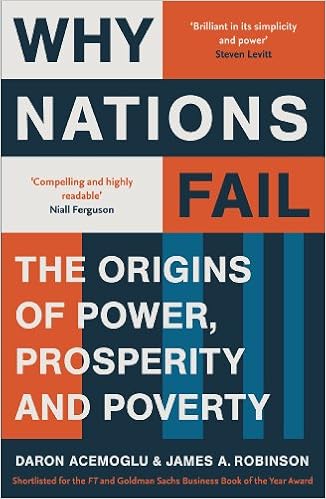
Since
its publication, Why Nations Fail continues
to garner wide interest and impressive
reviews from well-meaning scholars, media outlets and groups interested in the history,
politics, and economics of development. The Wall Street Journal Europe hailed the
book as “a splendid piece of scholarship and a showcase of economic rigor”. At
first glance, you might be fooled by its title that you are in for another
tedious read put together by authors whose scholarship has armed with the jargons
and technicalities of economic analysis, that can only be deciphered by old
white-haired professors who have spent most of their lives in the ivory tower
of academia. But this is certainly not the case as you begin to read this book.
The
authors begin by tickling the imagination of the reader with two separate
scenarios or case studies involving two communities existing side by side but
separated by a border. Although these communities share a lot in common – food,
music, ancestry, and culture – they have markedly different experiences in
terms of living standard or quality of life; while Nogales, Arizona, located in
the northern half of the border, in the United States of America, shares in
America’s political and economic institutions which are not only accountable to
the people but also cater to their needs, Nogales Sonora, a Mexican territory
to the south, is not so lucky as its people are stuck with the grim realities
of failing economic and social institutions. In analysing the reasons for these
untoward differences, the authors come up with a theory that remains the
dominant line of thought throughout the book: the fate of nations, whether they
succeed or fail, is determined by the kind of institutions they have which were
forged over many centuries. Subsequent chapters of the book try to elucidate
this theory by examining the experiences of different nations within their varied
historical contexts.
If
you are a lover of history, this book is set to take you through some of the
wildest adventures that saw to the birth of nations and the kind of institutional
processes and changes that helped to shape the lives of millions of peoples.
From Arizona and Sonora, we are led to the Americas of pre-colonial times when
Spain was still struggling to gain a colonial foothold on the continent. The
authors take us through different accounts of how the Spanish eventually
succeeded in this enterprise and established institutions that subjugated the
local populations and appropriated the proceeds of their labour. In most parts
of the Americas that came under Spanish rule such as Paraguay, Uruguay, Argentina,
Cuba, Mexico and a host of others, the pattern of colonial exploitation was
similar and remains evident in the emergence and persistence of anti-democratic
forces that pervade most of these countries till this day.
English
colonists in North America were not as successful as their Spanish counterparts
in the south and central parts, hence the emergence of a different state system
there. Readers will note with interest how the first company of English
colonists to arrive Virginia in 1607 made desperate appeals to England to send
them assistance in terms of food supplies and workmen. They were forced to fend
for themselves as the indigenous peoples they met there could not be forced to
work or provide food. Also to their dismay, they did not find precious metals
like gold they could have exploited to enrich themselves as was the case in
Spanish controlled areas. Therefore, the colonial settler in North America had
no choice but to take charge of his life and establish institutions that worked,
thereby laying an exemplary framework for future developments.
Next
comes the story of the Industrial Revolution and why it succeeded in Europe and
America. The birth of the revolution in England in the mid-18th century did not
come as a surprise as the English people had already made significant institutional
changes through the Glorious Revolution (1688-1689), which wrested power away
from the monarchy and vested it in an elected parliament. The establishment of
more inclusive and democratic political institutions would later give rise to
the passage of laws that changed the patent system in England, granting more
incentives to people for their expertise and industry and in the process,
igniting the greatest technological and economic advancement in modern history.
The experience in England was very much similar to the one in America and France
where two distinct revolutions in 1776 and 1789 respectively, helped to
dislodge reactionary political and economic forces in these societies and
establish the right institutional framework that attracted innovation and
development.
However, the Industrial Revolution did not
spread to other parts of the world as quickly as it did in Europe and America
because the institutions in these other parts were extractive in nature rather than inclusive. By extractive institutions, the authors refer to political
and economic arrangements that keep the people out of power, while ‘stealing’
the proceeds of their labour. The monarchies and feudal systems that pervaded
most of Africa, Asia and the Arab world under the Ottoman empire, were
extractive in nature and, therefore, slowed down the pace of the Industrial
Revolution in these parts. Although countries like Japan, China, South Korea,
Singapore, etc., later made significant institutional changes and started
investing in skills and new technologies, the effects of European expansion through
the notorious slave trade across the Atlantic and the subsequent colonial
exploitation of Africa meant that African nations never got the chance to
transform their indigenous political institutions along inclusive lines. Africa
simply inherited the pernicious political and economic structures of colonial
rule, the effects of which persist to this day.
Why Nations Fail, however, is not without its
shortcomings. Despite claims by the authors that their institutional theory is
almost foolproof in explaining the failure of nations and that leaders who lead
their nations to such failures through bad policies do so on purpose, the
experience of Tanzania under Julius Nyerere comes to mind as an exception. Nyerere
was a highly intelligent man whose integrity as a leader was without question. Yet
his Ujamaa, a homegrown model of
development, which formed the basis of his policies on social and economic development,
failed to lift his people out of their poor economic state. Of course, Nyerere
must have known the limitations of his policies which were couched in socialist
thought, he must have known that socialism suppresses individual initiatives
and the creative ability that drives individuals to innovate. But it is
difficult to sustain the argument that he led his people to poverty on purpose.
Furthermore,
the authors discard the culture and geography hypothesis as useful alternatives
in explaining the history of world inequality. While the institutional theory may
be useful in understanding the cause of inequality among the world’s peoples
today, it lacks the same explanatory power when situated in pre-colonial Africa
where culture, through lingering superstitious and religious beliefs, had a
significant impact on the level and pattern of development. Moreso, it is
difficult to rule geography out (in terms of propinquity) as a possible culprit
in the underdevelopment of Africa since many progressive pre-colonial African
communities (like the Igbo of Eastern Nigeria) that would have benefitted from
the Industrial Revolution at the time it began, could not do so because they
were far removed from the centre of it. Although
the authors are of the view that for economic growth to take place a certain
degree of political centralisation is necessary–which many pre-colonial African
communities lacked, the fact remains that many of these communities that would
have benefitted from the economic and technological boom in Europe during the
Industrial Revolution, never got the chance because they were nowhere close to
‘the centre of gravity'. If anything, they participated in it only as
subjugated peoples through colonial exploitation.
Notwithstanding
the gloomy picture the book paints about certain peoples and places, especially
about Sub-Saharan Africa where the condition of living smacks of horrid scenes
from the Hobbesian state of nature, the authors hold out hope in the possibility
of ending the vicious circles that have held African nations down for so long
and establishing virtuous ones. Botswana, China, and southern USA are good
examples of this possibility in contemporary history where extractive
institutions have been largely replaced by inclusive ones. The authors also
identify technology and education as two important engines of economic
prosperity, which nations that seek to develop must invest in.
All
in all, the book remains one of the best-researched works on development studies
available on the market and many readers will find its novellike rendering, its
greatest strength.
