BY UCHENDU, PATRICK C.
“It is only the story...that saves our progeny from blundering like blind beggars into the spikes of the cactus fence. The story is our escort; without it, we are blind…” ― Chinua Achebe, Anthills of the Savannah.
It is a story I am reluctant to tell. Yet it is a story we must tell. We must tell it for the sake of today’s children and for the sake of posterity. It is important for them to know how it all started. For you never can tell, it might help them know how it will all end. The late writer and sage, Chinua Achebe, was often quoted as saying, “that a man who does not know where the rain began to beat him cannot say where he dried his body.” (There Was A Country, 2012). This is now the case with Nigeria in her journey to nationhood.
Many history books are already awash with the story; how European powers with imperialist interests in Africa met in Berlin, Germany, between 1884/85 to share African territories among themselves like pirates scrambling for booties after a successful raid at sea; how the British launched their formidable military expeditions against the great empires and kingdoms of old-Lagos, Benin, Opobo, Iteskiri, Arochukwu, Sokoto, etc, all of which eventually fell one by one to British superior weaponry like a pack of cards; how one Miss Flora Shaw(later, Lady Lugard), a correspondent in the then Times of London, suggested that the British should call her newly acquired territories around the Niger River, Nigeria; how the British government charted a company, the United African Company (UAC), later renamed the Royal Niger Company, to administer the conquered peoples and their territories on behalf of the British government until the latter were ready to fully take over in 1900; and how Lord Frederick Lugard of the British imperial army successfully executed his plan of joining the north and south of Nigeria together in the famous (or, if you will, the infamous) amalgamation of 1914, becoming the first governor-general of the new country. So what else is there to learn about the amalgamation? What lessons can we draw from that singular event which gave rise to one of the most ethnically diverse countries in the world?
Before 1914 different parts of Nigeria were administered by the British as separate entities. There was, for instance, the Crown Colony of Lagos which was the seat of the British colonial administration in Nigeria. Lagos became a British colony in 1861, about ten years after the sacking of the king of Lagos, Oba Kosoko, who was accused of carrying on with the illegal trade in slaves long after it had been outlawed in Britain and in all British territories in 1807 and 1833 respectively. The Colony of Lagos was later annexed to the Protectorate of Southern Nigeria administered by a British high commissioner, Sir Ralph Moore, in the first amalgamation of 1906. Then there was the Protectorate of Northern Nigeria whose administration was naturally left in the hands of its conqueror, Lord Lugard, soon after the British government formally took over the administration of Nigeria in 1900.
History reveals that the amalgamation of 1914 was borne out of the need to safeguard British economic interests in Nigeria as no real attempt was actually made to truly unify the people as purportedly claimed by the colonizers. Since the middle of the 15th century AD, Africa has been a major economic interest to European powers. At first the major attraction of European countries in Africa was cheap labour, amply supplied through the Trans-Atlantic slave trade in which millions of able-bodied men and women were shipped out of the continent and condemned to work in the most despicable manner on farm settlements in newly acquired territories in the New World (the Americas). The advent of machines in Europe at the dawn of the industrial era in the 18th century AD, rendered human labour and, hence, the trade in slaves redundant. Slave trade was thus abolished and replaced with a new kind of trade; the so-called ‘legitimate trade’ which subordinated African economies to the demands of European industries for more than one hundred years, thereby laying a new foundation for the continued dominance of Europe over Africa that would outlast the colonial era. The product in high demand at the time was palm oil which was needed to service the machines in European factories. Other products like cocoa, groundnuts, and cotton would later be required for the production of consumer goods that were subsequently resold in African markets. Thus, the role of African economies in international trade as producers of raw materials for industrial use overseas was established. We do not need to go into what that meant to our own humble attempt at industrializing!
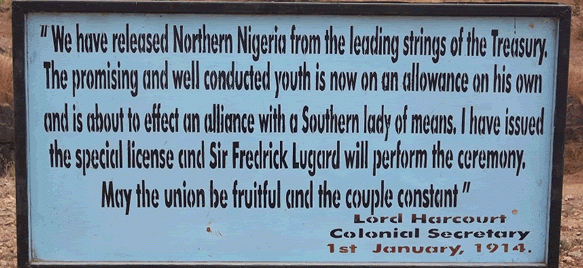
The idea of amalgamating the north and south of Nigeria was first mooted by Lord Lugard in the several dispatches he made for consideration in the British House of Commons between 1912 and 1913. Before this time, Lugard had brilliantly brought northern Nigeria under British rule with the conquest of the Sokoto Caliphate and was thus appointed high commissioner for the area. Needless to say, he did not find his stay funny. For northern Nigeria proved to be bad business for the British who had hoped to find as much resources there as they did down south. As it was not the policy of the British government to spend its taxpayers’ money in funding the administration of its territories overseas, cash-strapped Lugard must find another means of raising funds without relying heavily on the imperial treasury. This was the circumstance that gave birth to the idea of the amalgamation.
The British government must have given the whole idea a long hard thought: Why are we amalgamating? Is it possible to fashion a united country in the future out of this mass of ethnically diverse elements? In whose interest are we amalgamating? Again the economic interest of Britain was foremost in these deliberations. It is noteworthy that Britain was not the only imperialist power with vested interest in Africa. There were also the Portuguese, French, Germans, Belgians, etc. Of these, the French and Germans were the real threats to British spheres of influence in West Africa. Cameroon, for instance, was a German territory at the time which lay to the east of Nigeria. There was Chad and Benin, both French territories, to the north-east and west respectively, and Niger, also French, to the north. These European powers also understood the driving force behind imperialism and were ready to exploit any means, including territorial expansion, to protect their own interests too. Therefore, with your enemies so close at your door, it is important for you to fortify and prove to them that you are still master of the house. This was what the British also tried to achieve by letting the amalgamation proposal sail through its House of Commons.
As further proof that the amalgamation was not necessarily aimed at unifying the diverse elements of the new nation, the British introduced and sustained divisive policies among the people even after the event. In his famous book on the origin of the ethnic problem in Nigeria, Ethnic Politics in Nigeria (1980), Prof Okwudiba Nnoli provides irrefutable facts to show how British colonial policy espoused the idea of separate settlements for southern migrants living in the north, which resulted in the emergence of the so-called Sabongaris, or ‘Strangers Quarters’ in the area. This was done for fear the southerners might ‘corrupt’ the northerners with their radical and progressive outlook rooted in anti-colonial sentiments. Furthermore, the British left the north out of the country’s parliament for more than two decades(1922-1946), and rather chose to rule the area by mere proclamation, denying northern and southern leaders the opportunity of interacting with one another, a situation that threatened any future possibility of forging a common understanding between the two sides. Finally, in their blind haste to consolidate on the economic gains of colonial rule, the colonialists ensured that the social infrastructures they provided were such as could enhance the exploitation of local resources to the benefit of Britain. Hence, the first railways to be built in Nigeria (the Lagos Government Railway in 1898 and the Baro-Kano Railway in 1911) were laid to facilitate the movement of raw materials from the hinterlands to nearby seaports for eventual shipment to England. This had the effect of linking our local economies to England, thereby forestalling any possible interaction among the peoples of Nigeria that would have resulted had trade and commerce followed a more localized pattern.
Accordingly, after one hundred years of existence, we are still unable to forge a common understanding among our peoples, or develop a sense of common identity as Nigerians. Nigerians from one part of the country still see their fellow countrymen and women from other parts as strangers, or at worst usurpers. In this atmosphere of suspicion hostility is bred as each group tries to outstrip one another in the struggle for the nation’s resources. Elections are turned into theatres of war and political offices become the means of resolving ethno-religious wars and gratifying ethnic bigots! In these circumstances, it is not surprising that leadership emerges, in a desperate collusion with our debilitating colonial legacies, no longer as an objective force occupying the commanding heights of the society, but as a failed institution mired in ethnic dissensions and unimaginable acts of corruption!
For this reason most analysts and commentators on the condition of the Nigerian state regard the amalgamation of Nigeria as a fraud and the country as little less than a nation, at best as an amalgam with different conspicuous parts still in the process of integration, or, perhaps, disintegration! (See speech by Chief Richard Akinjide (SAN) at the public presentation of the book: Fellow Country Men- the Story of Coup d'états in Nigeria by Richard Akinola, June 2000).
As patriotic citizens, therefore, if it is still possible to use such terms in these times, we have a duty to facilitate the process of national integration. We can do this by our conduct towards our fellow citizens. We must learn to show tolerance and hospitality to people with beliefs, doctrines or creeds other than ours, who come from different ethnic or linguistic backgrounds. Our leaders and elites must also give up the pettiness of exploiting ethno-religious divisions and sentiments for cheap political gains. Rather, they must rise to the occasion and furnish the country with the dividends of good governance that have eluded it since independence.
Yes, our colonial experience may have set our country on the path of doom in the last one hundred years, but whether or not we make it to the next and what kind of country we hope to see then is entirely up to us.
(Originally published in a school magazine, The BOSSSLight, 4th Edition, 2014).

this is interesting... but the closure in a simple sentence is urging us to remain in Nigeria. The question is, who is killing who in Nigeria? who is intolerance? whose slogan is "Born to Rule"? no matter how noble men of our time may try to romance the issue of ONE NIGERIA, it is for their own interest not for the members of the public. we must go back to our roots. let people exist the way they were before the British experiment on us. The Biafra _Nigeria war is a typical example of the hatred Hausa/Fulani and Yoruba have for the Biafrans. Aburi accord is another issue Nigeria hate to discuss. We all know the truth and it is better we adhere to it before it is too late. Unity by force is a slavery. Once again, we should be allowed to exist as an entity which we were before the British intervened.Thanks..
ReplyDeleteOnyebuchi, I agree with you on the sense of urgency it requires to get things right in this country.Your comments here are highly appreciated. Thanks a lot.
ReplyDelete